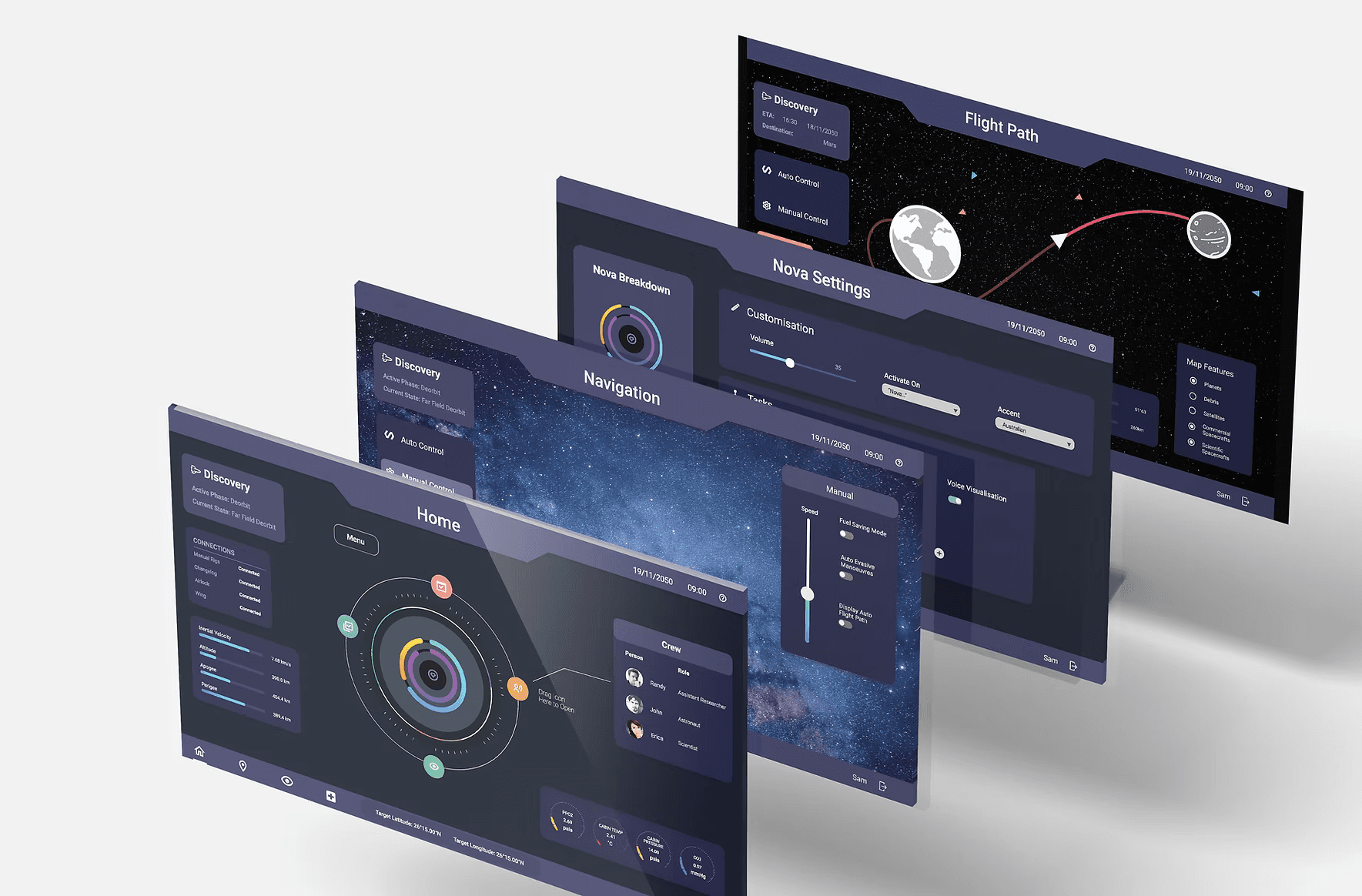
Nova: Designing navigational systems for deep space
Designing for scientific and medical complexity to create the system for tomorrow
Nova is a software navigational system that is compatible with wearables and touchscreen computers to provide personalised and precise assistance for the user to perform their job and uphold their mental health. I was the whole designer and creator for this project, completing the UX research, UX and UI design to create a speculative AI assistant and piloting system.
Nova doesn’t “solve” space navigation. It helps define what good human-centred design should look like when spacecrafts become more autonomous, and missions become more psychologically demanding.
Even though Nova is speculative, it maps directly onto real problems the space industry is already dealing with as missions get longer, more autonomous and more commercially driven.
How it supports the space industry’s trajectory:
Supports long-duration mission design, mirroring real Nasa missions
NASA is actively planning missions where astronauts are out of direct real-time contact with Earth. Nova shifts to onboard autonomy, where navigation, decision support and wellbeing systems are integrated rather than separate tools.Highlights the human factor in deep space systems as long haul becomes a mainstream issue
Current space tech is engineering-first. Nova prioritises mental health and cognitive load on equal footing with navigation performance, abandoning current space technology’s engineering first, people second approach. Nova addresses real concerns around isolation, fatigue, and decision-making under stress in long missions.Uses integrated systems for precision and customisation
The combination of a wearable, touch screen interface and AI assistant aligns Nova to real industry trends for longer travel. This is the move from standalone tools to connected ecosystems that adapt to astronaut state in real time.Informs human & AI interactions in high-risk environments
The orbital assistant, voice tone design and gesture-based interaction create built in checks and balances to ensure human control in sensitive situations.Provides a research led design lens for future space UX
Because you grounded it in pilot interviews and feasibility research, it demonstrates a method the industry values: designing future systems by translating adjacent-domain expertise (aviation → spaceflight) when direct access to astronauts is limited
The Second Space Race to Mars and Beyond: Designing for new challenges humanity faces
We are living in a second space race, but this time it’s to Mars and beyond. Governments and Private Companies are funding new advancements to get large amounts of people to Mars and beyond. Soon, interplanetary space travel will be available for the human race to travel between solar systems, and human colonies will begin to appear throughout the galaxy.
With the rise of Space Tourism, I wanted to speculate as to how people will navigate deep, uncharted space as travel times will span years to decades in space. I wanted to explore how this can be done with consideration to the pilot's mental health, as humanity has never been challenged with such extensive travel times.
How can future deep space navigational system balance functionality with mental health capabilities as journeys become years long. Currently, space flight is navigated on the ground. However as humanity travels into the stars, this will need to change to be independently driven in the vehicle. What will the future look like as humanity must navigate uncharted territory and what is this impact on mental health? How will people cope with increased accessibility into space in the future?
Designer vs Physics: Researching for feasibility
I wanted to design this to be feasible as possible, so first needed to understand space, physics and what is happening in this space. This was an unfamiliar area as I had not studied science since high school, however this was crucial to ensure what I designed could be practically implemented and align with the trajectory of where society and technology is heading.
The next challenge was finding people to interview, as I do not know any astronauts and the space industry is limited in Australia. I supplemented this with x2 interviews with commercial pilots. I made a judgement that semi-autonomous space piloting was in the future based on current research, as presumed the astronaut will take more of a pilot's role in the future. This comparison proved fruitful as I collected insights into their role, it’s future and how pilots address change and mental health.
Expanding the software to a wearable for a customised ecosystem
Upon synthesising my research I identified a need to prioritise the individual’s mental health for the whole journey more, acknowledging how the distinction between work and life may blur in the scenario. So to uplift the individual and ensure their wellbeing to complete their navigational responsibilities, I included a wearable hardware piece for the user to interact with. This inclusion expands the software into an ecosystem will be needed so they can be healthy out of hours. I decided to include a wearable in the ecosystem that connects to the navigational system, bringing the focus more on the user’s health and allowing for the potential for health data to be customise the system to specific needs.
12 people across 5 rounds of user testing to discover how the future functions and appears
I designed the UI system to invoke a futuristic ‘state of the art’ aesthetic with a streamlined UI panel that presents necessary functions when necessary. This was crucial to deliver the cutting edge presentation of the solution.
User Testing occurred with 12 people over 5 rounds of user testing, with feedback being used to iterate the design functionality and aesthetic. Particular focus was given to perfecting the the radial ‘orbit’ like design of the voice assistant. It was a challenge because it’s appearance was new, and not something users were familiar with as there was no similar UI element in use. The feedback enabled changes to the AI assistant to be more organic and intuitive, with more natural social interactions. The system was refined with streamlined gesture controls and aligning the interface with user expectations
I recorded voice lines to add a human touch to Nova, with a calming yet reaffirming tone to uplift the design. I animated the rotations of the orbit, voice assistant UI to be organic and move to exact voice commands, this made the product easier to engage with and less un-canny than speaking to a screen. It created a fun, tangible thing for people to speak to, making the design more intuitive and closer to expectations.
Astronauts + Nova = The Key To Tomorrow
Nova is a speculative AI navigational system designed for wearables and touch interfaces, supporting astronauts and pilots with mission-critical decision-making and integrated mental health support. It explored how deep-space travel could shift from ground-controlled operations to fully autonomous onboard systems, where both performance and wellbeing are essential
As the sole designer, I led everything from the end-to-end UX research to the high-fidelity prototype. The final design introduced an intuitive, gesture-based interface with an orbital AI assistant, the titular Nova. Nova demonstrates my ability to design complex, forward-looking systems by combining user research, interaction design and speculative thinking into a cohesive, human-centred product vision.